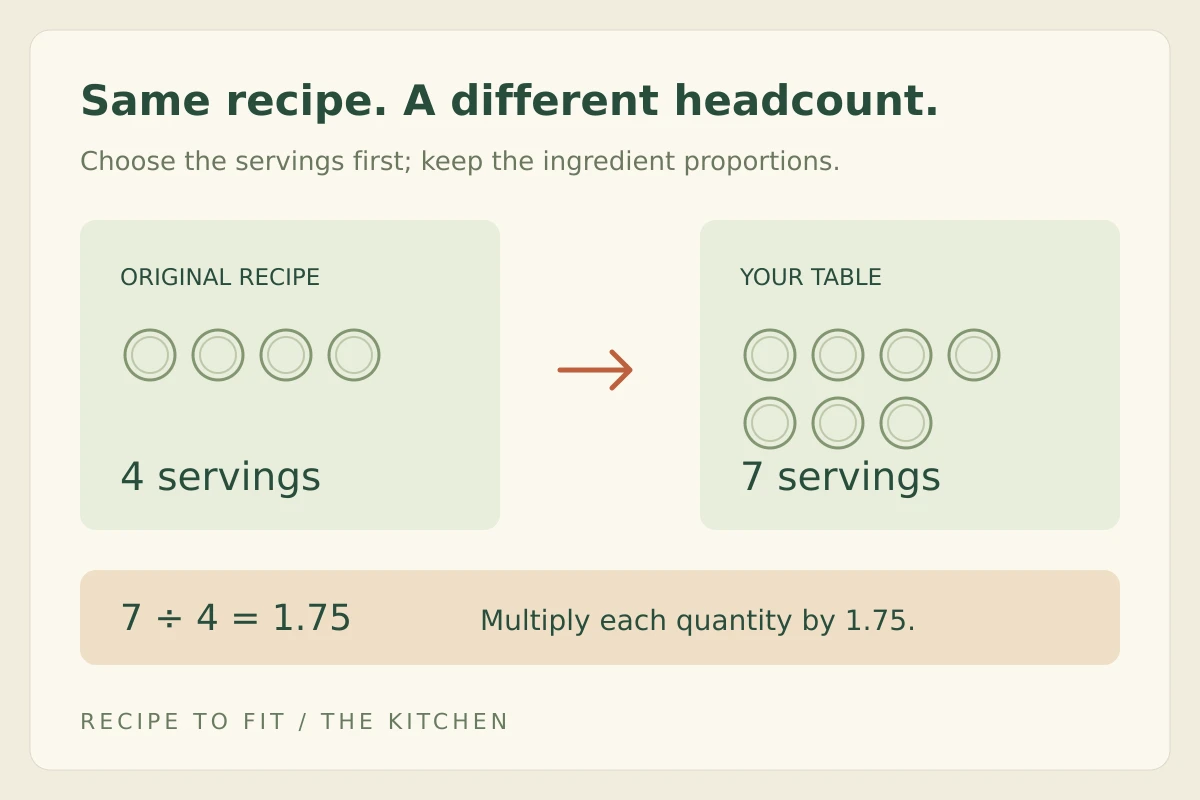
A recipe for four is a starting point. Your table might need two plates tonight and seven on Sunday. The useful question is how to change the ingredient amounts while keeping the recipe’s proportions.
The recipe-scaling formula
Divide the servings you want by the servings the original recipe makes. That answer is your multiplier. Multiply each specified ingredient quantity by the same number.
7 ÷ 4 = 1.75. Two cups become 3½ cups; one tablespoon becomes 1¾ tablespoons.
Keep the units consistent while you do the arithmetic. If the original says grams, work in grams. If it says teaspoons, scale the teaspoons. You can consider a separate unit conversion afterward, but changing servings does not require converting the entire recipe.
Start with a serving count you understand
“Serves 3–4” leaves a real choice. Four modest portions and three generous portions are different baselines. For seven diners, using four produces a multiplier of 1.75. Using three produces a multiplier of 7/3, or about 2.333.
Neither calculation tells you how hungry your guests will be. Choose the original portion size that matches your plan, then include everyone eating in the target number. If seven guests are joining you for dinner, the total may be eight rather than seven.
Separate ingredients from instructions
Before scaling, give each ingredient its own line. Put an Instructions heading before the method. This matters when an ingredient list and numbered steps arrive together from a screenshot, copied webpage, or cookbook file.
Check any extracted text against the original. A missing slash can turn ½ into 12; a faint decimal point can change an amount just as dramatically. A clean-looking result is only useful when the starting quantities were read correctly.
Read the adjusted amounts before cooking
Compare the original and resized quantities side by side. Small ingredients deserve the same attention as the main ones. Keep “to taste,” “as needed,” and unspecified garnishes as notes rather than inventing a quantity for them.
Amounts mentioned inside cooking directions need a separate check. Recipe to Fit preserves the original directions, so “add two cups” in a method still refers to the original batch. Use the adjusted ingredient table when measuring.
The cooking setup needs its own decision
The multiplier resizes ingredient amounts. It does not determine whether a pan will hold the food, whether a crowded tray will cook the same way, or whether a larger bake will finish at the original time. Check the recipe’s technique and doneness cues, and use separate batches when that makes the setup easier to manage.
A quick checklist
- Choose an original serving count.
- Count the total people you are feeding.
- Review imported fractions and units.
- Scale the quantities, then check the result.
- Review pans, directions, seasoning, and timing separately.
You do not need a new recipe every time the headcount changes. Start with a clear baseline and let the arithmetic handle the ingredient proportions.
Make it fit your table.
When your headcount changes, bring your recipe to the calculator and review the adjusted ingredients.
Open the recipe calculator →