A double batch starts with twice the specified ingredients. The rest of the plan deserves a fresh look.
What doubling actually means
Doubling a recipe uses a multiplier of two. A recipe for four becomes a recipe for eight. Two tablespoons become four, and 250 grams become 500. The ingredient ratios remain the same.
That calculation does not say “bake twice as long.” It also does not mean “turn the oven up.” Temperature and time are instructions about a cooking setup, not ingredient quantities to multiply.
Ask whether one pan can hold the new batch
Before measuring anything, look at the food volume and the capacity of your equipment. A saucepan, mixing bowl, baking dish, or food processor that worked for the original recipe may not have enough usable space for a double batch.
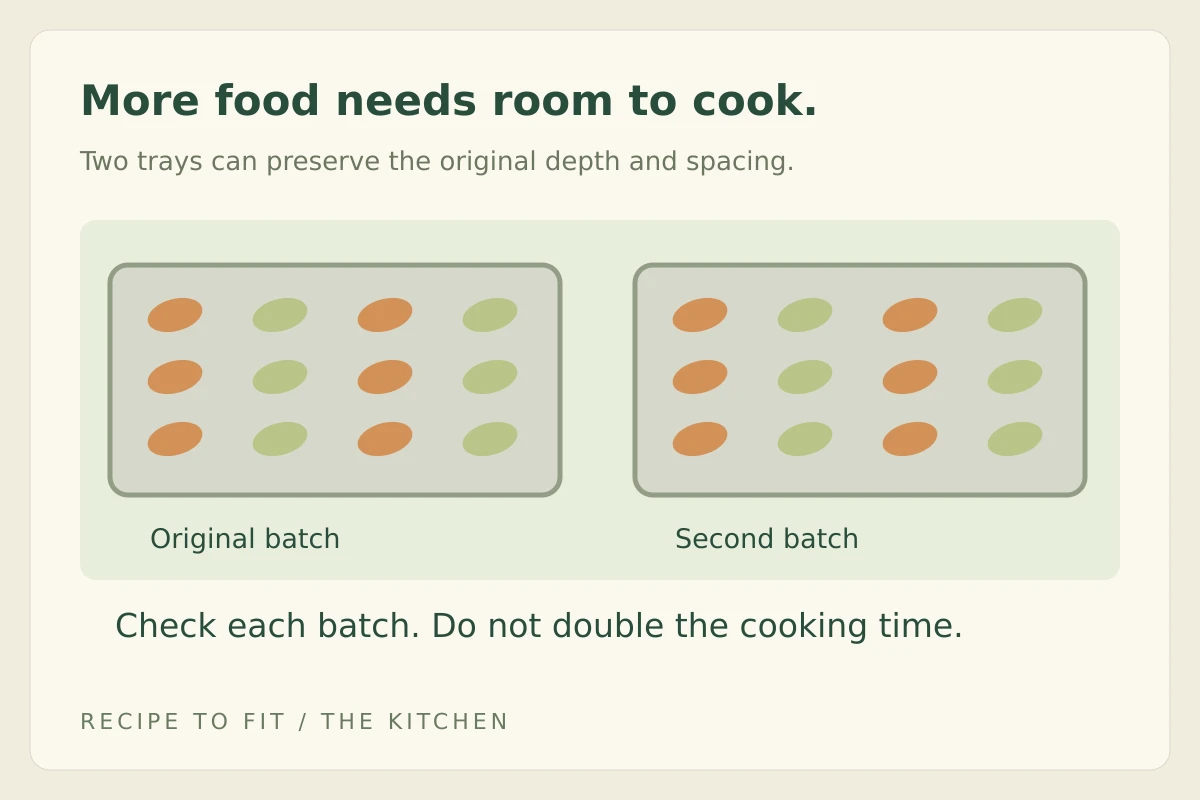
Two separate batches can be a simpler choice than changing every piece of equipment. If you use two baking dishes or trays, read the original recipe for any placement or rotation instructions and check each batch individually.
Think about depth and crowding
More batter in the same dish changes depth. More vegetables on the same tray changes how closely the pieces sit together. Those differences can affect the cooking process, even though the ingredient arithmetic is correct.
The calculator cannot see your dish, stove, oven, or ingredient preparation. Treat its output as an ingredient list and use the method to decide how to arrange and cook the food.
Check the original directions for quantities
A direction such as “reserve half a cup of the liquid” still contains an amount. When Recipe to Fit preserves a method, that text remains part of the original recipe. Decide whether it is a quantity tied to the original batch or a technique instruction before using it.
This is why the side-by-side list matters. Measure from the adjusted ingredients and read the preserved directions with the original batch in mind.
Review small ingredients and doneness
Seasoning and raising agents still appear in the scaled list, but a large change in batch size deserves closer recipe-specific judgment. Do not treat a numeric result as proof that an untested cooking setup will work exactly the same way.
Use the recipe’s doneness cues and any relevant food-specific safety guidance. If a recipe is sensitive or unfamiliar, separate batches keep more of the original setup intact.
A better question than “How much longer?”
Ask: “Can I keep the original depth, spacing, and method?” That question gives you a more practical plan than multiplying the clock. Let the calculator double the ingredients, then let the recipe guide the cooking.
Make it fit your table.
When your headcount changes, bring your recipe to the calculator and review the adjusted ingredients.
Open the recipe calculator →