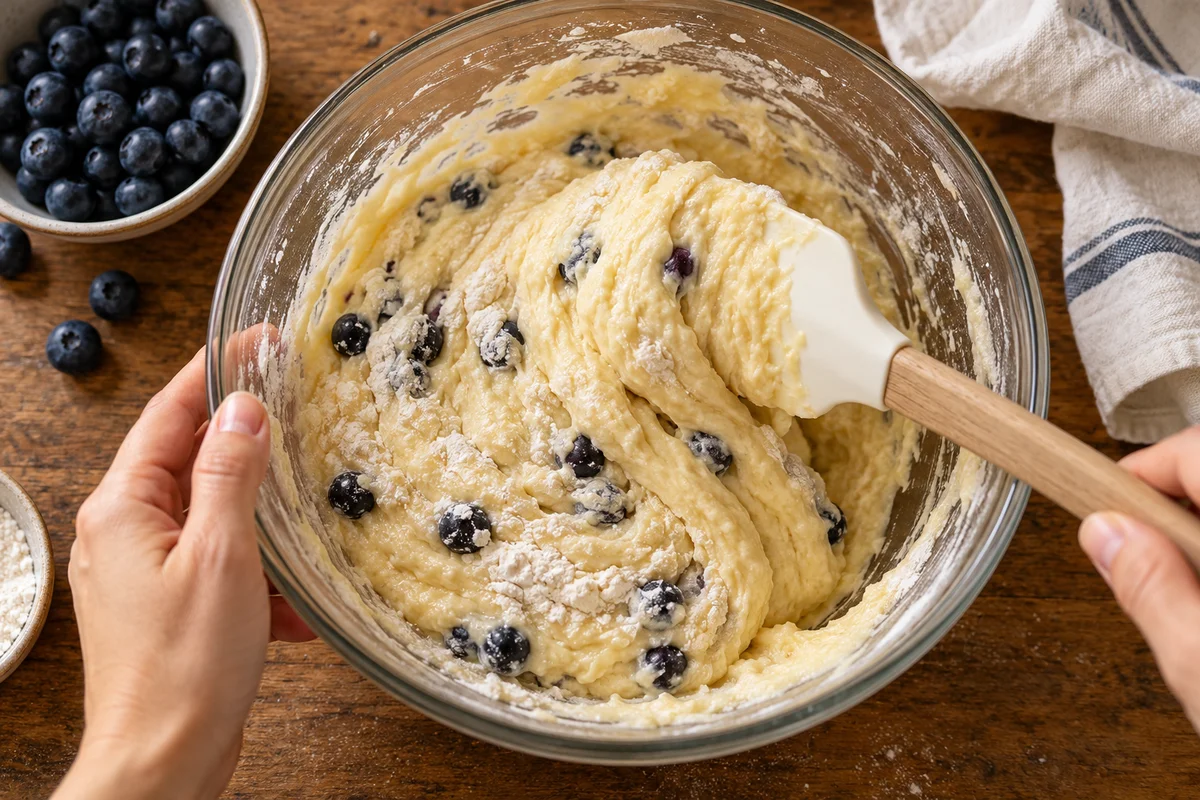
“Fold gently” can sound like an instruction you are supposed to understand already. It is simply a particular way of combining ingredients: scoop from underneath and turn the mixture over itself, rather than beating it until perfectly smooth.
Know why the recipe asks you to fold
In a muffin or quick-bread batter, gentle mixing helps combine wet and dry ingredients without working the flour more than necessary. In a foam-based cake, folding has another job: distributing ingredients while keeping as much of the whipped mixture’s air as possible.
Those are related goals, but the recipes are not interchangeable. A sturdy muffin batter tolerates handling differently from whipped egg whites. Follow the order in your recipe and use its description of the finished batter as your guide.
Use a bowl with room to move
Choose a bowl that leaves space above the mixture and a broad, flexible spatula. A bowl filled to the rim makes it difficult to lift and turn the batter without spilling or pressing it down.
Prepare mix-ins before you start combining wet and dry ingredients. Chopped fruit, chocolate chips, or blueberries should be ready when the recipe calls for them, so you do not keep stirring while deciding what to add.
Learn the folding motion
- Hold the bowl steady with one hand.
- Slide the spatula down through the middle of the mixture.
- Sweep it along the bottom and up the side, lifting batter from underneath.
- Turn that lifted batter over the top.
- Rotate the bowl a little and repeat, checking the bottom for hidden dry ingredients.
Think “lift and turn,” with deliberate strokes. Scraping the bottom matters: a smooth-looking surface can hide a pocket of flour underneath. Use the spatula to bring that pocket into the rest of the batter rather than beating the entire bowl harder.
Stop at combined, not polished
Many muffin batters look a little lumpy when properly combined. Small lumps are different from a dry mound of flour. Stop when the ingredients are evenly incorporated to the degree your recipe describes; do not chase a silky texture if the recipe never asks for one.
For whipped mixtures, watch for large streaks of egg white or dry ingredients while avoiding unnecessary extra strokes. Some recipes first mix a small portion of the foam into a dense base to lighten it. Do that only when the method calls for it.
Add delicate mix-ins near the end
When instructed, fold berries or other fragile additions into the nearly combined batter with a few final strokes. Repeated stirring can crush fruit and streak the whole mixture. Portion the batter into prepared pans once it is ready, following the recipe’s timing.
If you have already overmixed
You cannot undo the mixing by letting the spatula rest. Finish the recipe rather than adding extra flour or liquid on a guess, and compare the texture after baking. Next time, prepare the pans first, slow down the strokes, and stop sooner.
The skill is less about counting folds than learning what your batter looks like at each stage. Watch the mixture, use the bottom of the bowl, and leave the electric mixer aside when the recipe calls for a spatula.
Make it fit your table.
When your headcount changes, bring your recipe to the calculator and review the adjusted ingredients.
Open the recipe calculator →